


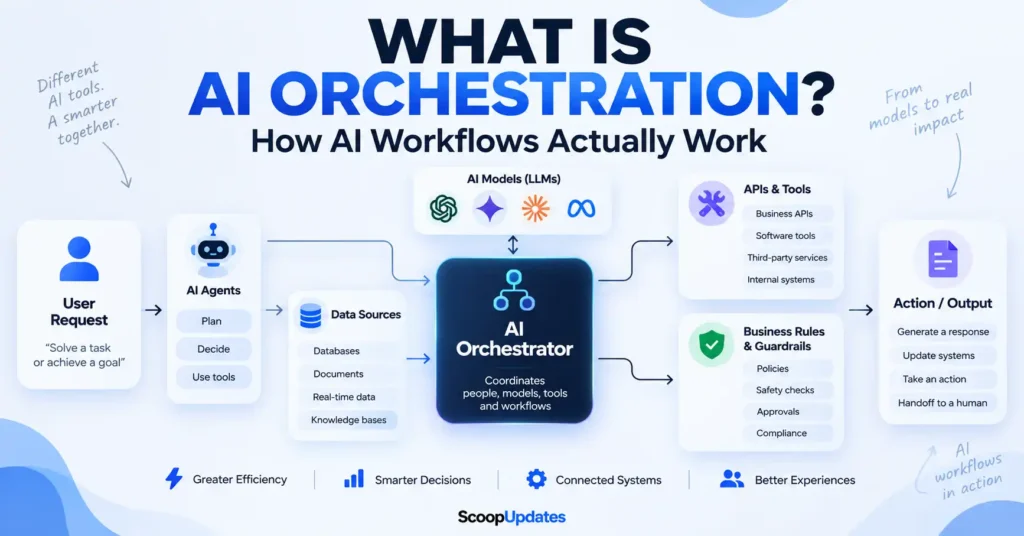
An AI model can answer a question. But a real AI-powered business system may need to do much more.
Imagine asking an AI system to review a customer complaint, check the customer’s previous orders, determine whether a refund is allowed, draft a response, update the support platform, and send the case to a human if the refund exceeds a certain amount.
A single AI model does not necessarily handle that entire process on its own.
Something needs to decide what happens first, which data should be retrieved, which model or tool should be used, what happens when a step fails, and when a human needs to take control.
That coordination is where AI orchestration comes in.
AI orchestration is the process of coordinating AI models, agents, data sources, APIs, software tools, and business rules so they can work together as part of a complete workflow.
It is becoming increasingly important as businesses move from simple AI chatbots toward AI systems that can perform multi-step tasks.
AI Orchestration Explained in Simple Terms
Think about an orchestra.
A violin, piano, trumpet, and drum can each produce music independently. But putting all of them in the same room does not automatically produce a good performance.
They need coordination.
AI systems face a similar problem.
A company might have:
- a large language model (LLM)
- an internal database
- a search system
- several business APIs
- specialized AI models
- one or more AI agents
- human approval processes
Each component can perform a particular job. AI orchestration determines how those components work together to complete a larger task.
The orchestration layer can decide which component runs, what information it receives, where its output goes next, and what should happen if something goes wrong.
In other words:
AI models provide intelligence. AI orchestration organizes how that intelligence is used.
What Does an AI Workflow Actually Look Like?
The easiest way to understand AI orchestration is to follow a request from beginning to end.
Suppose an online retailer creates an AI customer-support system.
A customer writes:
“My headphones stopped working after three weeks. Can I get a replacement?”
The final answer might appear almost instantly, but several processes can happen behind the scenes.
Step 1: The system receives the request
The workflow starts when the customer’s message enters the application.
Before sending everything directly to an LLM, the system may first identify what type of request it is.
For example:
Intent: Product replacement
Product: Headphones
Reason: Product failure
Action required: Check replacement eligibility
This gives the workflow a clearer direction.
Step 2: The orchestrator decides what information is needed
The AI cannot safely decide whether the customer qualifies for a replacement without more information.
The orchestration system may therefore call several tools.
It could retrieve:
- customer account information
- order date
- product details
- warranty status
- previous support requests
- company return policy
This is an important difference between an ordinary chatbot and an orchestrated AI workflow.
The system is not relying only on information stored inside the language model. It can connect the model with relevant external information.
This approach is closely related to retrieval-augmented generation (RAG), where outside information is retrieved and supplied to an AI model before it produces an answer.
Step 3: The right AI model or tool is selected
Not every task needs the same model.
One model might be useful for understanding natural language, while another specialized system might handle fraud detection or document classification.
The orchestration layer can route tasks accordingly.
For example:
Customer message → language model
Warranty document → document-processing model
Account risk → fraud detection system
Refund eligibility → business rules engine
This is called model or task routing.
It can improve efficiency because companies do not need to send every request to their largest or most expensive AI model.
Step 4: Context moves between the different steps
Each stage of the workflow generates information that may be required later.
Suppose the system discovers:
- the headphones were purchased 21 days ago
- the product has a one-year warranty
- no previous replacement has been requested
That information becomes part of the workflow’s state or context.
The next AI component needs access to the relevant context so it can make a useful decision.
Managing this state becomes especially important in longer AI workflows.
Without good orchestration, different components can lose context or receive inconsistent information.
Step 5: Business rules are applied
AI does not always have complete freedom to decide what happens.
Organizations may place strict rules around certain actions.
For example:
If purchase age < 30 days → replacement allowed
If purchase age > 30 days → check warranty
And
If refund value > ₹10,000 → human approval required
If fraud risk is high → send case to specialist
These rules help prevent an AI system from taking actions it is not authorized to perform.
Step 6: The AI generates or performs an action
Once the system has enough information, the AI may draft a response:
“Your headphones are covered under our replacement policy. I can start a replacement request for you.”
But generating text may not be the final step.
The workflow could also call an API to:
- create a replacement order
- generate a return label
- update the customer record
- send an email
- create a support ticket
This is where AI begins moving from simply answering questions to performing work.
Step 7: The workflow records what happened
Production AI systems need visibility into their actions.
The orchestration layer may record:
- which model was called
- what tools were used
- how long each step took
- whether an error occurred
- which actions were completed
- whether a human approved something
These logs help developers understand why a workflow behaved in a particular way and investigate problems when something fails.
The Main Components Behind AI Orchestration
Although implementations differ, most AI orchestration systems coordinate several common building blocks.
| Component | What It Does |
|---|---|
| AI models | Understand, generate, classify, predict, or reason over information |
| AI agents | Work toward goals and decide which actions or tools to use |
| Data sources | Provide business or external information |
| APIs and tools | Allow AI systems to interact with other software |
| Workflow logic | Determines the order in which tasks happen |
| State and memory | Maintains useful context across steps |
| Guardrails | Restrict unsafe or unauthorized actions |
| Monitoring | Tracks performance, failures, costs, and behavior |
| Human approval | Adds oversight for sensitive decisions |
AI orchestration brings these pieces together rather than expecting one model to do everything.
AI Orchestration vs AI Agents
These terms are increasingly used together, but they describe different things.
An AI agent is generally a system designed to pursue a goal, make decisions, and use tools with some level of autonomy.
AI orchestration is the broader coordination mechanism that determines how agents, models, tools, data, and workflows interact.
For example, a company could have separate agents for:
- researching a topic
- analysing data
- writing a report
- reviewing the report
An orchestration system could determine when each agent runs and how the output of one agent becomes the input of another.
If you’re trying to understand where agents fit into the wider AI ecosystem, our guide to AI Agents vs AI Assistants explains the difference between autonomous agents and more reactive AI assistants.
AI Orchestration vs Traditional Automation
Traditional automation normally follows predefined instructions.
For example:
New invoice received → extract fields → enter information into accounting system → send confirmation.
The sequence is predictable.
AI workflows can introduce more flexible decision-making.
An AI system might first examine the invoice and decide whether it needs:
- standard processing
- fraud review
- human verification
- translation
- additional documentation
That makes the workflow less rigid.
| Traditional Automation | AI Orchestration |
|---|---|
| Mostly fixed rules | Can combine rules with AI decisions |
| Predictable paths | May use dynamic workflow paths |
| Structured inputs | Can work with unstructured information |
| Usually deterministic | AI outputs can vary |
| Limited reasoning | Can include models and agents |
| Easier to predict | Requires stronger monitoring and guardrails |
The two are not competitors. Many real systems combine traditional automation with AI orchestration.
Where RAG Fits Into AI Orchestration
Retrieval-augmented generation is often one part of an orchestrated workflow rather than the entire workflow.
Suppose an employee asks:
“How many paid leave days can I carry into next year?”
The orchestration system might:
- identify the request as an HR-policy question;
- search the company’s current HR documents;
- retrieve the relevant policy;
- send that information to an LLM;
- generate an answer grounded in the retrieved document;
- provide the source to the employee.
RAG helps provide the information.
Orchestration manages the whole sequence.
This distinction matters because modern AI applications often contain multiple techniques operating together.
Why AI Orchestration Is Becoming More Important
Early generative AI applications were relatively simple.
A user sent a prompt to a model, and the model returned text.
Modern AI applications can involve far more moving parts.
Businesses increasingly want AI systems that can search databases, call APIs, use software tools, coordinate agents, retrieve live information, maintain context, and perform actions.
As the number of components increases, connecting everything with custom code can become difficult to maintain.
Orchestration provides a structured coordination layer.
It can also make systems easier to observe because developers can see how requests travel through different models and tools.
This becomes particularly important with agentic AI, where AI systems can perform multi-step actions with greater autonomy.
Greater autonomy also creates new security concerns. Organizations deploying agents should understand risks such as Shadow AI, where employees use unapproved AI tools, as well as prompt injection attacks that attempt to manipulate an AI system’s instructions.
A Practical AI Orchestration Example
Consider a company using AI to research competitors.
A user enters:
“Create a competitive summary for our three biggest competitors.”
Instead of asking one LLM to produce everything from memory, an orchestrated workflow could operate like this:
Request received
↓
Planning agent identifies research tasks
↓
Search tools collect current information
↓
Data is cleaned and organized
↓
Research agent extracts important findings
↓
Analysis model compares competitors
↓
Writing model creates the report
↓
Verification step checks important claims
↓
Human reviews the final document
This approach divides a complex goal into smaller tasks.
It can also make it easier to replace or improve individual components without rebuilding the entire system.
What Happens When an AI Workflow Fails?
This is one of the less glamorous but most important parts of AI orchestration.
Real systems fail.
An API may become unavailable. A model may return an invalid response. A database query may time out. An agent may choose the wrong tool.
A production orchestration system therefore needs failure-handling mechanisms.
These can include:
Retries: Try a failed operation again.
Fallback models: Send the task to another model when the preferred model is unavailable.
Timeouts: Stop processes that run too long.
Validation: Check whether an output meets expected requirements.
Human escalation: Send uncertain or sensitive cases to a person.
Logging and tracing: Record what happened so developers can investigate.
Reliable AI is not only about choosing a powerful model. It is also about designing what happens when the model or one of its dependencies fails.
The Security Problem Gets Bigger With Orchestration
Connecting AI to more tools also increases what the system can potentially access.
A chatbot that only generates text has relatively limited ability to affect external systems.
An AI agent connected to email, cloud storage, databases, payment systems, and administrative tools can potentially do much more.
That makes permissions critical.
An AI workflow should generally receive only the access required for its task.
For example, an AI support agent may need permission to read an order status but should not automatically receive unrestricted access to the company’s entire customer database.
Input validation, tool permissions, audit logs, approval checkpoints, and security testing become increasingly important as AI systems gain the ability to take actions.
Prompt injection is particularly relevant because malicious instructions hidden in webpages, documents, emails, or other external content can potentially influence systems that process that information.
Our complete guide to prompt injection explains how these attacks work and why tool-connected AI systems require additional protection.
Does Every AI Application Need Orchestration?
No.
A simple application that sends a prompt to one model and returns the response may not need a sophisticated orchestration layer.
Orchestration becomes more valuable when the application involves several components, such as:
- multiple AI models
- AI agents
- external tools
- databases
- APIs
- RAG systems
- multi-step decisions
- approval workflows
- complex error handling
Adding orchestration unnecessarily can create additional complexity.
The architecture should match the problem being solved.
AI Orchestration and the Future of AI Software
The importance of orchestration is likely to increase as AI systems become more capable of acting rather than merely responding.
The important shift is from:
Prompt → Model → Answer
to:
Goal → Plan → Retrieve → Decide → Use Tools → Verify → Act → Monitor
That second model describes a system, not just an AI model.
It also explains why discussions about AI are increasingly moving beyond which LLM has the best benchmark score.
The model is only one component.
The reliability of a real AI application also depends on how well its models, agents, data, tools, permissions, monitoring systems, and human oversight work together.
Readers interested in this transition can also explore how agentic AI works and our explanation of AI Agents vs AI Assistants to understand how autonomous AI systems differ from conventional assistants.
The Bottom Line
AI orchestration is the coordination layer that turns separate AI capabilities into a functioning workflow.
It determines how models, agents, tools, APIs, data sources, rules, and human approvals work together to accomplish a larger task.
A model might understand a customer’s question. An agent might decide what needs to happen. A database might provide the required information. An API might perform the action.
Orchestration connects those pieces.
That is why understanding AI orchestration is becoming increasingly important. The next generation of AI applications will not be defined only by smarter models. They will also depend on how effectively those models can work with the rest of the software world.