


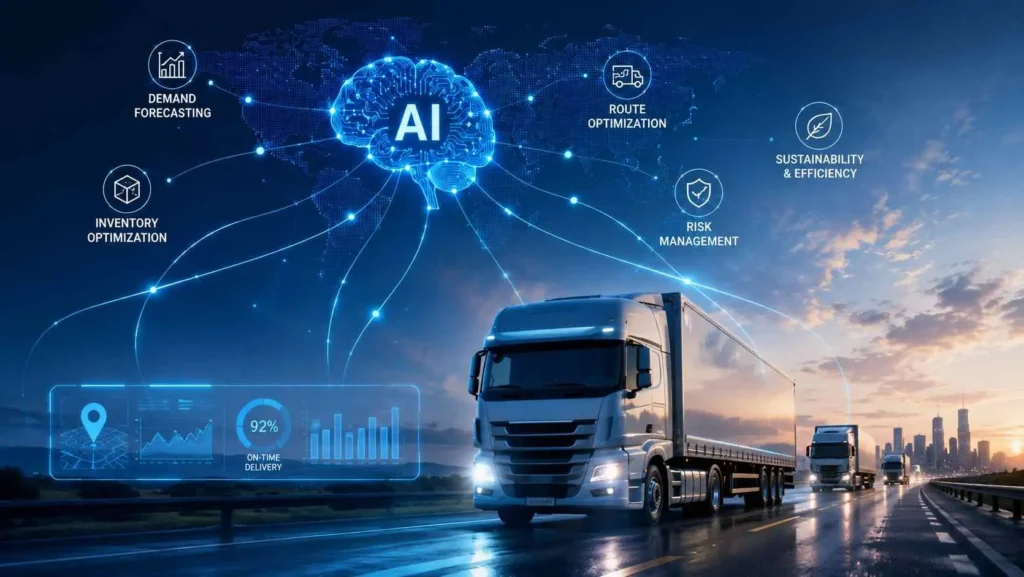
Logistics relies on constant coordination between shippers, carriers, warehouses, suppliers, customers, and service providers. Every shipment generates massive amounts of data and requires numerous operational decisions. When goods move from origin to destination, stakeholders must track physical locations, verify shipping documentation, communicate status updates, and manage unexpected delays. Processing this information quickly and identifying potential problems early can mean the difference between on-time delivery and costly disruption.
While news headlines focus on autonomous trucks or warehouse robotics, the true impact of artificial intelligence in logistics is far broader. Much of the immediate opportunity exists in everyday operational workflows that keep transportation networks running efficiently behind the scenes.
What Does AI in Logistics Mean?
In simple terms, artificial intelligence in logistics refers to software technologies that analyze operational data, recognize patterns, and generate predictions or recommendations to improve decision making. Instead of relying solely on manual checks, modern AI systems learn continuously from historical and real-time data.
Key technologies powering these operations include:
- Predictive analytics: Forecasts events like traffic congestion or volume spikes based on historical patterns.
- Machine learning: Improves software calculations over time without manual reprogramming.
- Generative AI: Summarizes updates, drafts communications, and processes unstructured text.
- Intelligent automation: Connects separate software tools to execute repetitive tasks automatically.
- Computer vision: Scans barcodes, reads freight labels, and inspects cargo condition.
Together, these capabilities support both physical supply chain activities and administrative management.
6 Ways AI Is Changing Logistics
Artificial intelligence is currently applied across several core functions within transportation and supply chain management. Here are six primary areas where it delivers practical value:
- Route Optimization: AI algorithms analyze live traffic, weather forecasts, delivery windows, driver availability, and historical travel speeds simultaneously to calculate optimal vehicle routes dynamically.
- ETA Prediction: AI models combine historical transit durations with real-time GPS coordinates, driver rest requirements, and local weather alerts to calculate accurate estimated arrival times.
- Shipment Visibility: AI consolidates data from carrier portals, tracking tools, and internal systems into a single operational view, flagging potential delays early so dispatchers can take action.
- Warehouse Operations: Inside fulfillment centers, computer vision systems scan incoming packages for damage instantly, while intelligent picking algorithms direct warehouse staff along optimal paths.
- Demand and Capacity Planning: AI models analyze past shipping trends, seasonal shifts, and economic indicators to forecast future volume needs, helping companies align staffing, warehouse space, and carrier contracts.
- Exception Management: AI continuously scans tracking data to detect anomalies such as missed pickups or delayed freight, escalating urgent issues directly to human operators.
The Less Visible Side of AI in Logistics
When people picture technology in transportation, they often think of automated fulfillment hubs or self-driving trucks. However, logistics is not only about moving vehicles and handling physical packages. Beneath every physical shipment lies an enormous administrative layer.
Every shipment produces dozens of unstructured communications and document types. Freight quotes, commercial invoices, bills of lading, customs paperwork, carrier emails, and tracking updates pass between multiple parties daily. Traditionally, employees must read these documents manually, rekey information into internal software, verify rates, and answer routine customer inquiries.
This administrative burden slows down operations and introduces human error. AI helps bridge this gap by extracting, classifying, comparing, summarizing, and routing unstructured information automatically. These less visible workflows are becoming an important part of AI in logistics, particularly when businesses need to connect information from documents, emails, and operational systems.
Benefits of AI for Logistics Teams
Integrating artificial intelligence into daily operations transforms how logistics providers handle workload volumes. Rather than replacing human expertise, AI acts as an operational multiplier that enhances team productivity.
Key benefits include:
- Faster processing: Automated document extraction converts hours of manual data entry into instant processing.
- Better shipment visibility: Consolidated real-time data offers clear end-to-end visibility across global freight movements.
- Reduced manual work: Routine status checks, email responses, and data entry execute automatically in the background.
- Faster exception detection: Automated alerts highlight delays or discrepancies as soon as they occur.
- Improved customer communication: Access to accurate tracking data enables proactive, clear updates for clients.
- Better use of employee time: Staff can focus on strategy, vendor relationships, and complex problem solving rather than administrative paperwork.
Challenges of Implementing AI in Logistics
Deploying artificial intelligence in logistics operations involves distinct practical challenges due to complex supply chain environments and legacy software infrastructure.
Primary implementation hurdles include:
- Fragmented systems: Connecting modern AI tools to older legacy databases requires significant technical integration effort.
- Inconsistent data: Inaccurate or incomplete input data reduces the reliability of AI recommendations and forecasts.
- Cybersecurity requirements: Managing operational data across automated tools demands strict security standards and access controls.
- Employee adoption: Staff members require proper training, clear communication, and support to adapt to automated workflows.
- Inaccurate AI outputs: AI models can misinterpret complex or non-standard documents if configured incorrectly.
- Handling exceptions: Logistics environments are dynamic, requiring human intervention when unusual situations arise.
Maintaining strong human oversight remains essential to ensure operational quality across non-standard events.
How to Start Using AI in Logistics
Adopting artificial intelligence does not require an immediate overhaul of existing supply chain infrastructure. Organizations can achieve quick, measurable results by focusing on specific operational bottlenecks first.
A practical implementation framework includes:
- Identify one repetitive process: Focus on a time-consuming workflow like status processing or document extraction.
- Measure current performance: Establish baseline metrics for processing speeds, error rates, and operational costs.
- Determine where AI can assist: Select an AI solution tailored to that specific document or data type.
- Integrate with existing systems: Connect the tool to your core transportation management software.
- Define escalation rules: Set clear threshold guidelines for transferring complex cases to human staff.
- Pilot the solution: Test the tool on a controlled subset of daily shipments.
- Measure and expand: Evaluate results against baseline metrics, refine process rules, and expand AI usage to additional workflows.
Suitable initial workflows include shipment status processing, document extraction, quote preparation, exception classification, and customer updates.
The Future of AI in Logistics
The evolution of artificial intelligence in supply chain management is moving through distinct stages, advancing from simple visibility to predictive forecasting, automated execution, and intelligent workflow orchestration.
As these technologies continue to mature, the goal is not to eliminate human workers from logistics operations. Instead, AI handles increasingly routine information processing tasks automatically. This shift allows logistics professionals to spend less time on manual data entry and focus more energy on managing exceptions, strengthening vendor relationships, making strategic decisions, and delivering better service to clients.
Conclusion
Artificial intelligence is becoming increasingly relevant across the logistics lifecycle, from strategic transportation planning to the administrative back-office work surrounding each shipment. Companies do not need to automate everything at once to see results. Starting with one measurable operational bottleneck provides a practical path toward broader AI adoption, sustained operational efficiency, and long-term competitiveness.