
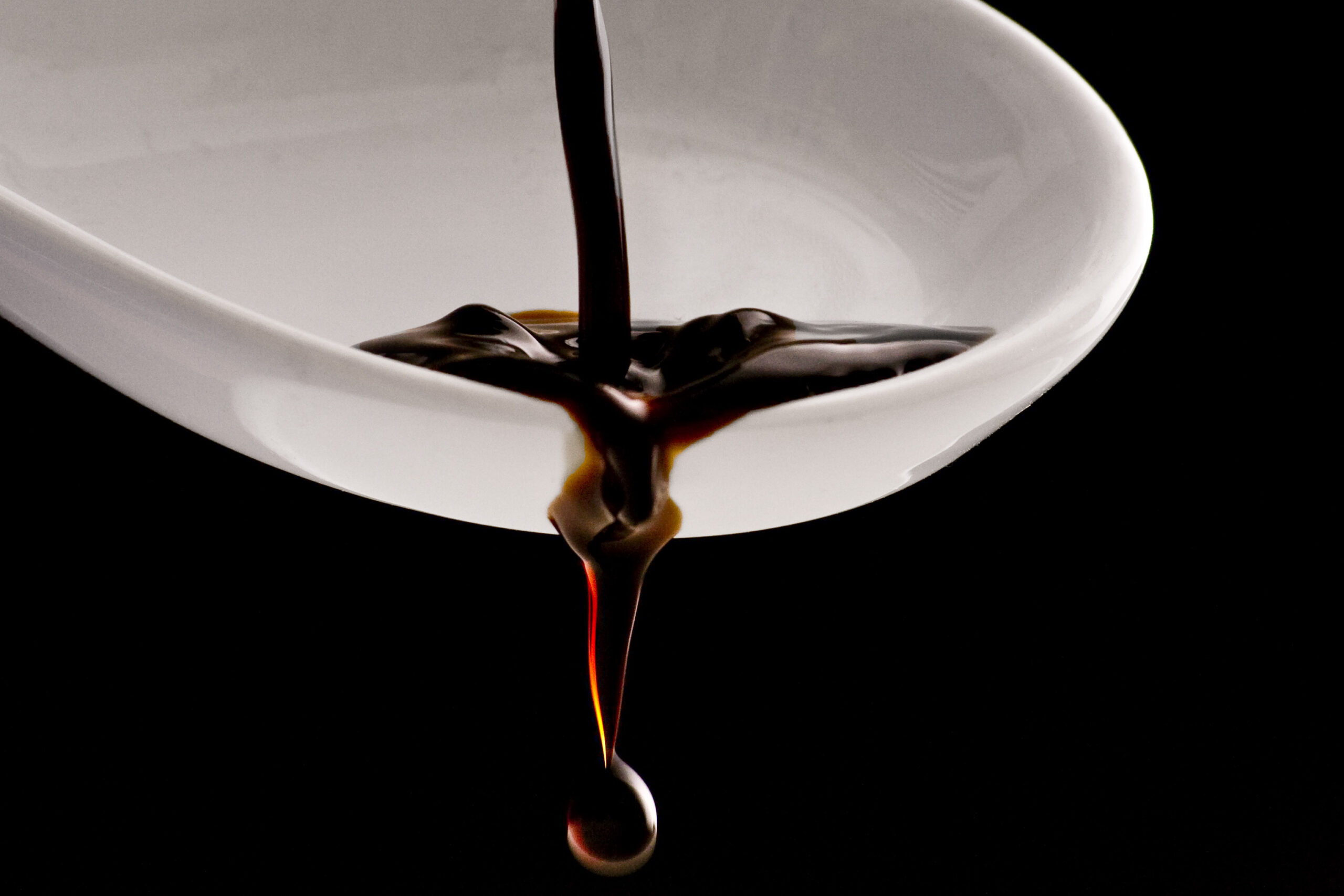
Balsamic vinegar is one of those products that seems familiar to everyone, yet still manages to surprise. Simply changing the pairing or the moment of the meal reveals different nuances – sweeter, more intense, or more aromatic. Its unique balance between soft notes and acidity makes it difficult to place into a single category. It can be delicate or bold, discreet or the main character, depending on how it is used. This ability to adapt to dishes keeps it relevant over time, without ever truly needing to reinvent itself.
A flavor that evolves over time
One of the most interesting characteristics of balsamic vinegar is its evolution. It is not a fixed flavor: it changes with aging and with the natural concentration of the product. Even products such as the balsamic vinegar of Acetaia Leonardi, obtained from slowly processed must, demonstrate how maturation affects density and aromatic intensity.
Over the years the liquid becomes darker, softer, and more persistent, while sharper notes fade. This explains why just a few drops can alter the character of a dish. Balsamic vinegar does not cover ingredients – it accompanies them: on fresh vegetables it enhances freshness, while on richer preparations it adds balance. The result is a condiment capable of offering different sensations while remaining recognizable, which is why it continues to intrigue even those who have used it for years.
Why it continues to win over different cuisines
Balsamic vinegar has a quality that few other condiments possess: it moves naturally between tradition and experimentation. It originates in a specific context but does not remain confined there. Today it is used on very different dishes, from classic recipes to modern creations.
The reason lies in its balance: the sweet component softens, while the acidic one cleanses the palate. This makes it suitable for both light preparations and more structured dishes. In everyday cooking it enhances a simple salad, while in professional kitchens it is chosen to give depth to meats, fish, or cooked vegetables. Even in unexpected pairings it finds its place because it does not dominate – it complements.
Its strength lies precisely here: it requires no special technique to use, yet it can still transform the perception of a dish. For this reason, it appears in very different gastronomic contexts, maintaining a recognizable identity while adapting to distant culinary styles.
From tradition to creativity at the table
While balsamic vinegar is rooted in an ancient tradition, it continues to offer new inspiration in the kitchen. Its use is not limited to typical dishes: it can become a creative ingredient capable of surprising even in simple combinations. A few drops on fresh strawberries, aged cheese, or grilled meat immediately change the profile of the dish.
This happens because balsamic vinegar does not add only acidity, but a combination of sweetness, aroma, and texture that enriches the whole. Even in everyday cooking it can be an interesting ally: adding it at the right moment – often raw – preserves its characteristics.
It is precisely this versatility that makes it a product that never stops surprising. Every use opens a new possibility without complex transformations. In this case, tradition and creativity do not exclude each other – they coexist in the same ingredient.