
Artificial intelligence is becoming a normal part of everyday work. Employees use AI to write emails, summarize documents, analyze spreadsheets, generate code, create presentations, research competitors, and complete many other tasks faster.
This can improve productivity, but it also creates a problem that many organizations are only beginning to understand: shadow AI.
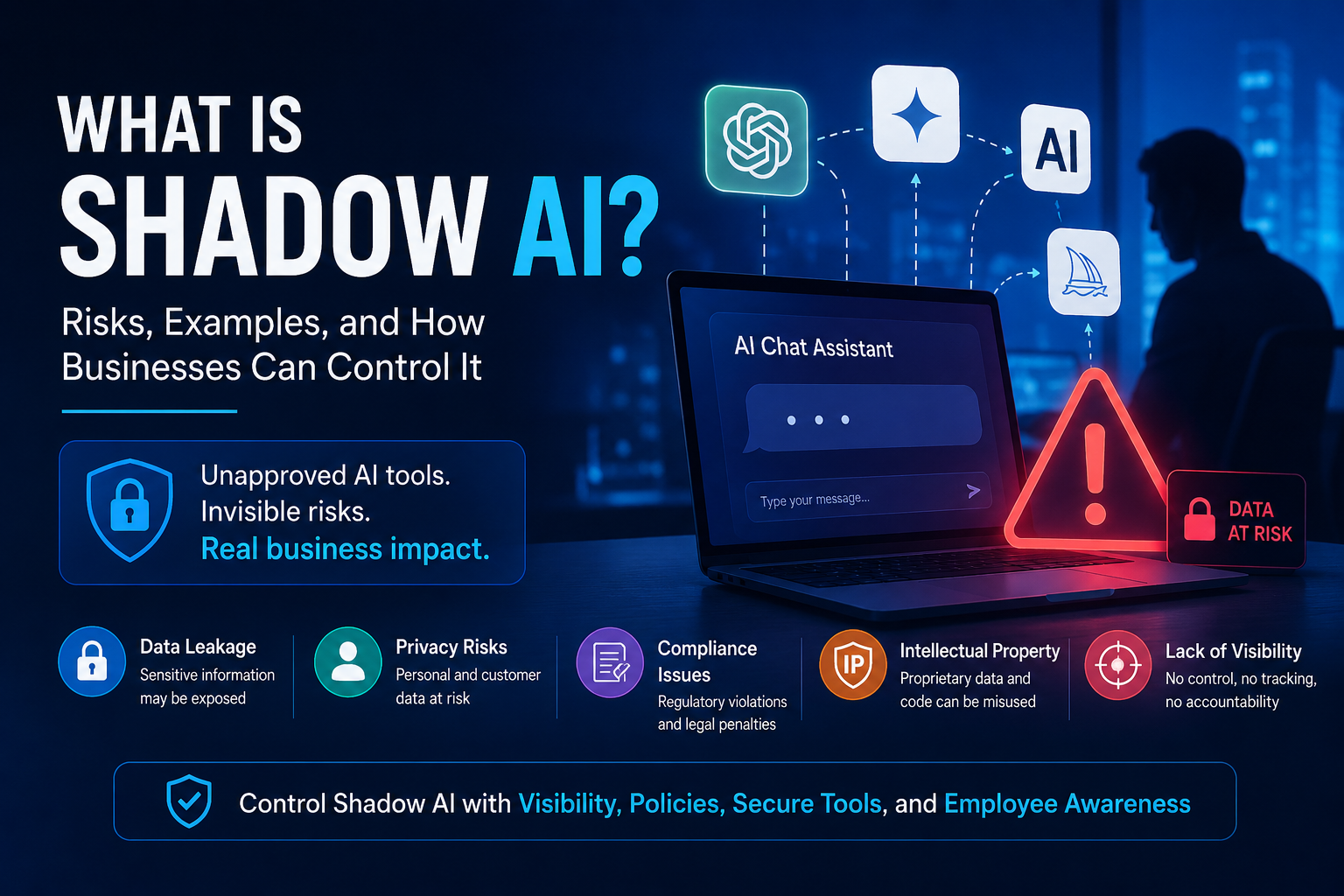
Shadow AI happens when employees use artificial intelligence tools for work without the knowledge, approval, or oversight of their organization’s IT, security, or compliance teams. The employee may simply be trying to save time. However, entering company information into an unapproved AI service can create risks involving sensitive data, privacy, security, intellectual property, compliance, and accuracy.
The problem is therefore not AI itself. AI can provide significant business value when it is used responsibly. The real issue is unmanaged AI use.
For businesses, the goal should not be to block every AI tool. A better approach is to understand where shadow AI comes from, identify the risks, provide approved alternatives, and create practical rules employees can actually follow.
What Is Shadow AI?
Shadow AI refers to the use of AI tools, models, applications, browser extensions, assistants, or AI-powered services within a business without official approval or proper organizational oversight.
It is similar to the older concept of shadow IT, where employees install software or use cloud applications without permission from the IT department. Shadow AI takes the same problem further because users may send information to external AI models or allow AI applications to interact with company data.
For example, imagine an employee receives a long confidential report and needs to create a short summary. Instead of spending an hour reading it, the employee copies the entire document into a public AI chatbot and asks for a summary.
The task may be completed in seconds.
But several questions immediately appear:
Where did the uploaded information go? How does the AI provider process it? Is the information stored? Does the company’s agreement with a customer allow the data to be shared with this service? Does the IT department even know the tool is being used?
If nobody inside the organization can answer those questions, the business has a shadow AI problem.
This distinction is important because AI itself can offer substantial benefits. Our guide to artificial intelligence and business growth explains how AI can help businesses analyze information and improve decision-making. Shadow AI is different because those benefits are being pursued outside the company’s approved systems and controls.
Shadow AI vs. Approved AI
The easiest way to understand shadow AI is to compare it with approved AI.
With approved AI, the organization knows which tool employees are using. The tool may have gone through security, privacy, legal, and technical reviews. Administrators may have control over accounts, access permissions, retention policies, integrations, and the type of information users are allowed to enter.
With shadow AI, those protections may not exist.
An employee might create a personal account on an AI service, install an AI browser extension, connect an AI meeting assistant to work calls, or upload business documents to a tool that has never been reviewed by the company.
The same technology can therefore be useful in one situation and risky in another. The difference is visibility, approval, governance, and control.
Why Is Shadow AI Growing?
Shadow AI usually does not begin with bad intentions.
Employees often discover AI tools that solve real problems. If an AI application can turn a 30-minute task into a five-minute task, people naturally want to use it.
Several factors are making shadow AI more common.
AI Tools Are Easy to Access
Many generative AI services can be opened directly in a browser. Users may not need to install traditional software or request administrator access.
Some services also provide free accounts, which removes another barrier.
This makes AI adoption very different from older enterprise software. Employees can begin using a new tool before the IT department even knows it exists.
Employees Want to Work Faster
Workers are under pressure to answer emails, analyze information, create content, prepare reports, write code, and handle repetitive tasks.
AI can reduce some of that workload.
A marketing employee may use AI to brainstorm campaign ideas. A developer may use an AI coding assistant. A salesperson may ask AI to summarize customer information. A manager may upload meeting notes and ask for action items.
These uses can appear harmless, but the risk changes when confidential or regulated information is involved.
Businesses May Not Provide Good Alternatives
Shadow AI can also be a sign that employees have a genuine need that the company has not addressed.
Simply telling workers “do not use AI” does not remove that need.
If employees believe an external tool helps them perform their jobs better, some may continue using it quietly. Businesses should therefore investigate why workers are turning to unauthorized AI instead of assuming the problem can be solved through restrictions alone.
Common Examples of Shadow AI
Shadow AI can appear in almost every department.
One common example is an employee using a public generative AI chatbot to rewrite a confidential email. Another is a developer pasting proprietary source code into an external coding assistant to identify an error.
A human resources employee might upload resumes or employee information to an AI tool and ask it to compare candidates. A salesperson could paste customer notes into an AI assistant to prepare a follow-up message.
Other examples include:
- Uploading internal reports to an AI summarization service.
- Using an unapproved AI meeting recorder during company calls.
- Installing AI browser extensions on a work computer.
- Connecting an AI assistant to company email or cloud storage.
- Using personal AI accounts for business work.
- Generating customer-facing information without reviewing the output.
- Uploading contracts to an AI service for quick analysis.
- Using AI image, video, or voice tools without checking licensing and usage rules.
- Allowing autonomous AI agents to interact with business applications without proper permissions.
The common factor is not the particular tool. It is that the AI is being used outside the organization’s normal approval, monitoring, and governance process.
What Are the Main Risks of Shadow AI?
The seriousness of shadow AI depends on the type of tool, the information being processed, how the service handles that information, and what the AI-generated output is used for.
Several risks deserve particular attention.
1. Sensitive Data Leakage
Data exposure is one of the biggest concerns.
Employees may enter customer records, financial information, internal strategies, product plans, source code, contracts, passwords, meeting notes, or other confidential information into AI applications.
Once company information leaves approved systems, the organization may have less control over how it is stored and processed.
This is why employees need clear guidance about what information can and cannot be entered into external AI services.
A simple rule can help: if the information would be unsafe to publish publicly, employees should not paste it into an unapproved AI tool.
2. Privacy Problems
AI applications can create privacy issues when employees upload information relating to customers, employees, patients, applicants, or business partners.
Organizations may have legal or contractual responsibilities concerning how personal data is collected, processed, transferred, stored, and deleted.
Using an AI service without reviewing its privacy practices can therefore create risks that go beyond ordinary cybersecurity.
3. Compliance Risks
Businesses in regulated industries often have strict requirements for handling data.
An employee can unintentionally bypass those controls by using an external AI application.
The organization might then struggle to determine what information was submitted, where it went, who had access to it, and how long it was retained.
Good governance becomes especially important as AI moves deeper into business operations. This is also why organizations preparing for wider AI adoption should consider a broader AI readiness strategy rather than treating every AI tool as an isolated technology purchase.
4. Intellectual Property Risks
Employees may use AI with proprietary source code, unpublished research, product designs, marketing plans, or other intellectual property.
There can also be questions about AI-generated outputs themselves.
Businesses should understand the terms of the AI products they approve and establish policies for how proprietary information can be used with them.
5. Inaccurate AI Outputs
AI-generated answers can sound confident while still being incomplete, outdated, misleading, or incorrect.
This becomes dangerous when employees treat AI output as verified information.
Imagine an AI system producing an incorrect calculation, inventing a legal reference, misunderstanding a customer requirement, or generating inaccurate research. If the employee copies the answer directly into business work, the error can spread.
The problem is related to the broader challenge discussed in our article about the risks of AI misinformation.
Human review remains important, especially when AI output influences important decisions.
6. Lack of Accountability
Businesses cannot properly govern technology they do not know they are using.
If dozens of employees independently adopt different AI services, IT and security teams may have no complete record of:
- Which AI applications are being used
- Who is using them
- What information is being shared
- Which accounts have access
- What external services are connected
- How AI-generated output is being used
This creates blind spots.
If a security incident occurs later, investigating it becomes much more difficult.
7. Inconsistent Business Decisions
Different employees may use different AI tools for similar tasks.
One team may use an approved enterprise AI platform while another relies on a free public chatbot. The models may produce different answers, use different information, and follow different privacy practices.
This can result in inconsistent processes and decisions across the organization.
Why Simply Banning AI May Not Work
A complete AI ban may sound like the safest option, but it can create another problem.
Employees use shadow AI because the technology provides value.
If a company bans every AI service without providing a useful alternative, employees may find workarounds. The organization then loses even more visibility.
A better question is:
What are employees trying to accomplish with these tools?
If workers frequently use AI to summarize documents, perhaps the business needs an approved document assistant.
And if developers are using external coding assistants, the organization can evaluate enterprise alternatives that provide suitable security controls.
If employees need AI for research, the company can define approved services and clear rules for the type of information that may be entered.
Governance works better when it supports productivity rather than simply blocking it.
How Businesses Can Control Shadow AI
Businesses need both technical controls and human-focused policies.
Step 1: Discover How AI Is Already Being Used
Before creating rules, organizations need visibility.
IT and security teams should identify the AI services employees currently access. Depending on the company’s technology environment, this may involve reviewing application inventories, browser activity, cloud access logs, software installations, connected applications, and network traffic.
The objective should initially be understanding, not punishment.
Organizations need to know which tools employees find valuable and which ones create unacceptable risks.
Step 2: Create a Clear AI Acceptable-Use Policy
Employees should not have to guess what is allowed.
A useful AI policy should explain:
- Which AI tools are approved.
- Which tools are prohibited.
- What information must never be entered into public AI systems.
- When human review is required.
- Whether AI-generated content can be used externally.
- How employees can request approval for a new AI service.
- Who should be contacted when an AI-related incident occurs.
Keep the policy simple enough for employees to understand.
A 40-page document that nobody reads will not solve shadow AI.
Step 3: Classify Business Data
Not all information carries the same risk.
Organizations can classify data into categories such as public, internal, confidential, and highly restricted.
Employees can then receive clear instructions.
For example, public marketing information may be acceptable for certain approved AI services, while customer records, passwords, financial information, health data, proprietary source code, and unreleased product information may require stronger controls.
Step 4: Provide Approved AI Tools
One of the strongest ways to reduce shadow AI is to give employees safe alternatives.
Approved enterprise AI services may provide better administrative controls, identity management, access permissions, logging, and contractual protections than personal accounts.
Employees are more likely to follow company rules when the approved solution is useful and easy to access.
Organizations developing more customized AI systems should also consider security throughout the development lifecycle. Our guide on training LLMs for scalable and secure AI solutions provides additional background on enterprise AI implementation.
Step 5: Apply Least-Privilege Access
AI applications should not automatically receive access to every business system.
If an AI assistant only needs access to a particular folder, it should not be able to read the entire company drive.
The same principle applies to email, customer databases, code repositories, calendars, and internal knowledge systems.
Give AI applications only the permissions required for their approved purpose.
Step 6: Train Employees
Shadow AI is partly a technology issue, but it is also a people issue.
Employees need practical examples.
Instead of saying, “Never share sensitive data with AI,” explain what sensitive data means in everyday work.
Show workers why pasting a customer contract, unpublished financial report, employee record, password, API key, or proprietary source code into an unapproved chatbot can be risky.
Training should also cover AI limitations, including inaccurate answers and the need for human verification.
Step 7: Create a Simple Approval Process
Employees will continue discovering new AI applications.
Businesses therefore need a quick process for reviewing them.
The process could examine:
- Data handling practices
- Security controls
- Privacy terms
- Access permissions
- Data retention
- Integrations
- Compliance requirements
- Business value
- Cost
- Reliability
A slow approval process can encourage employees to bypass IT. The review process should therefore be thorough but practical.
Step 8: Monitor AI Use Continuously
AI governance is not a one-time project.
New applications appear quickly, and existing services frequently add AI features.
Businesses should regularly review which AI tools are being used, what permissions they have, whether those tools are still needed, and whether their risk level has changed.
Unused accounts and integrations should be removed.
What Should Employees Do Before Using a New AI Tool?
Employees can use a simple five-question check before giving an AI application company information:
- Is this AI tool approved by my organization?
- Does the information contain confidential, personal, customer, financial, or proprietary data?
- Do I know how the service handles the information I submit?
- Can I complete the task using an approved company tool instead?
- Will a qualified person review the AI-generated result before it is used?
If the employee cannot confidently answer these questions, the safest choice is to contact the appropriate IT, security, privacy, or compliance team before proceeding.
Shadow AI Can Also Reveal Business Opportunities
Shadow AI should not be viewed only as a security failure.
It can reveal where employees are struggling.
If many workers independently use AI for the same task, they may be identifying a workflow that is ready for improvement.
For example, repeated use of AI for document summaries could show that employees spend too much time processing lengthy reports. Frequent use of AI coding tools might reveal opportunities to improve the development process.
Organizations can use this information to decide where approved AI investments would provide the greatest value.
In this sense, shadow AI discovery can become part of an organization’s AI strategy.
The goal is to move useful AI activity out of the shadows and into a controlled environment.
Building a Responsible AI Culture
Technology controls alone cannot eliminate shadow AI.
Employees need to understand that AI governance is not designed simply to slow them down. It exists to protect customers, coworkers, intellectual property, business information, and the organization itself.
At the same time, management must recognize why workers are adopting AI.
The most effective culture encourages employees to experiment responsibly, ask questions, report new tools, and suggest useful AI applications without fearing punishment for raising concerns.
IT, security, legal, compliance, HR, and business teams should work together instead of treating AI as the responsibility of one department.
That collaboration makes it easier to balance innovation with security.
Final Thoughts
Shadow AI is the unauthorized or unmanaged use of artificial intelligence tools within an organization. It is becoming an important business issue because AI services are easy to access and can quickly improve productivity.
The same convenience, however, can expose confidential information, create privacy and compliance problems, introduce inaccurate information into business processes, and leave organizations without visibility into how their data is being used.
Businesses should not respond by assuming every AI tool is dangerous.
A stronger strategy is to discover current AI use, understand why employees are using particular tools, establish clear policies, classify sensitive data, provide approved alternatives, control permissions, train employees, and continuously monitor the AI environment.
AI adoption will continue to grow. Trying to eliminate every unofficial experiment is unlikely to be a sustainable strategy.
The better objective is to make responsible AI easier than shadow AI.
When employees have secure tools, understandable rules, useful training, and a simple process for requesting new technology, businesses can benefit from AI innovation without giving up control of their most important information.