
Shopping for a small cartridge battery can be a bit of a guessing game. One listing emphasizes battery capacity, another is all about voltage control, and a third focuses mostly on the display. The products don’t look that different at first glance.
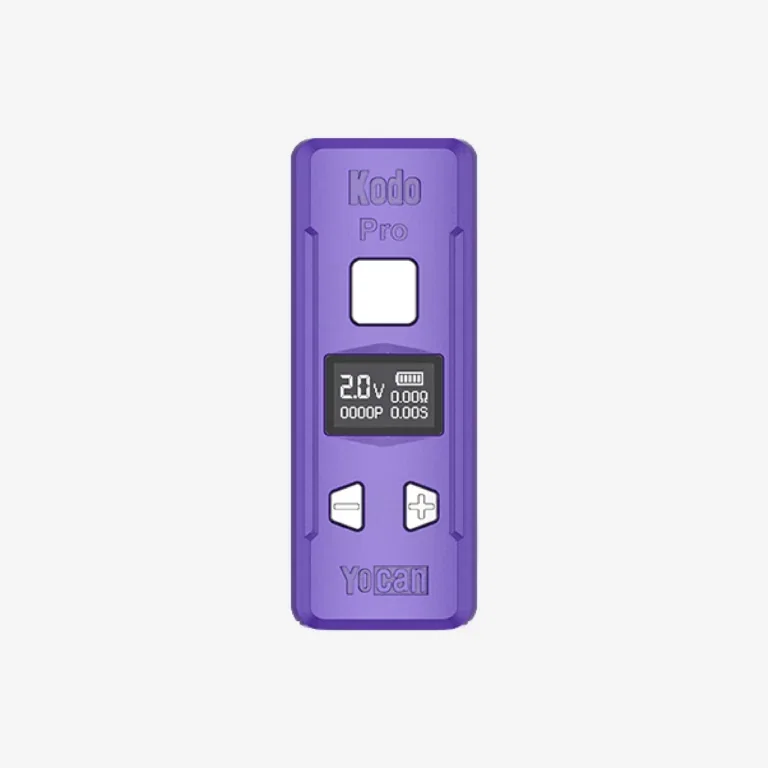
The Yocan kodo pro has a few specs that are worth checking before deciding if it fits a buyer’s needs. Its small size is part of the story, but charging, cartridge compatibility and controls need to be addressed.
Looking at these details will help you separate the wheat from the chaff in terms of truly useful features vs features that sound good in a product description.
The 400mAh Rating: What Does It Tell Buyers?
Battery capacity is one of the first things that people look at. The Kodo Pro has a 400mAh battery but that figure alone doesn’t really say much to anyone about how many days or hours a charge will last.
Usage makes a difference. So do voltage settings, cartridge resistance, and the condition of the rechargeable battery. Someone who uses a device occasionally may have a very different charging routine from someone who uses it frequently.
That is why comparing capacity figures alone can be misleading.
When checking the Kodo pro battery, look at the charging connection as well. This model uses USB Type-C, which is a familiar connector for many people. Even so, the manufacturer’s charging instructions should be followed rather than assuming every cable or power source is suitable.
One other detail is worth remembering: rechargeable batteries lose capacity as they age. A used device may not perform exactly like a new one, even when the model and original specifications are identical.
Voltage Settings Are Not Just Numbers on a Screen
The Kodo Pro offers an adjustable voltage range from 1.8V to 4.2V, with changes in 0.1V increments. This gives users more precise control than a device with only a few fixed settings.
But does a wider range automatically make a battery better? Not necessarily.
The cartridge being used has its own requirements. Voltage affects heat, and a setting that is unsuitable for a particular cartridge may affect performance or damage components. Following the cartridge manufacturer’s guidance matters more than simply choosing the highest available setting.
A useful comparison comes down to a few practical questions:
- Is the complete voltage range clearly stated?
- Can the setting be adjusted in small increments?
- Are cartridge compatibility requirements provided?
- Are the operating instructions easy to find?
For some buyers, several adjustment options will be useful. Others may prefer a simpler device with fewer controls. Neither preference is wrong; the important thing is knowing what the specifications offer.
Is the OLED Display Actually Useful?
The Kodo Pro has an OLED screen that displays information such as battery status, selected voltage, cartridge resistance, a puff counter, and a timer.
That’s quite some info for a compact device. But a screen’s value is whether it makes the device easier to understand.
Being able to check the current voltage without guessing is practical. Seeing battery status can also help users identify when charging may be needed. The puff counter and timer might be less important for someone who doesn’t care about those details.
When comparing the Kodo pro, look at the information you see and if the controls are easy. A screen full of figures is not much of an advantage if the display is hard to read or the settings are confusing.
Check the Cartridge Before Assuming It Will Fit
A matching connection does not guarantee complete compatibility. This is one of those details that can easily be overlooked when a product listing makes a device sound suitable for almost everything.
The Kodo Pro uses a 510-thread connection and is specified for compatible cartridges with resistance above 0.8 ohms. The cartridge’s own specifications should be checked before purchase.
The phrase Kodo pro yocan may appear in product searches and listings, but the name alone does not establish whether a particular cartridge is suitable.
Before buying, check:
- The connection type and physical fit.
- The cartridge’s stated resistance.
- Any compatibility limits in the manufacturer’s instructions.
- Whether the connection can be secured without forcing or overtightening it.
These checks take little time and can help prevent an avoidable mismatch.
Preheat and Cut-Off Features Deserve a Mention
Some features receive less attention than battery capacity or voltage, even though they are part of the overall specification.
The Kodo Pro has a preheat function that runs for 10 seconds at 1.8V. Its usefulness depends on the compatible cartridge and the instructions supplied for that cartridge.
The device also incorporates a safety cut-off, which is specified to operate after more than 15 seconds of continuous operation. This information is useful for comparing models but does not take the place of safe operation.
Always follow the instructions of the device, use compatible parts and charge it according to the manufacturer’s recommendations.
Small Dimensions, Everyday Practicality
Measuring approximately 53 × 20 × 17 mm, the Kodo Pro is a compact option. That could be appealing to someone who wants a smaller device, rather than carrying around a larger battery.
Dimensions are only part of the decision, though. Button placement, screen visibility and access to the charging port also affect convenience.
Harbor City Hemp lists the Kodo Pro among its product offerings. Buyers are advised to check the current product details for availability, included accessories and the specifications of the version being sold.
Final Thoughts
A product description might list a lot of features but it doesn’t tell you which are most important. When comparing compact batteries, pay attention to battery capacity, voltage range, charging connection and cartridge compatibility.
The Yocan kodo pro comes with a 400mAh battery, variable voltage, USB-C charging and OLED display. Whether it makes sense in combination depends on the buyer’s needs and on the cartridge itself.
Instead of looking for the best looking or the biggest number, check for specifications that matter for compatibility and actual usage. A little thought before you buy is often more useful than finding out something important after.