

Facing criminal charges can be an overwhelming experience, with profound implications for one’s future. The legal landscape is intricate, and navigating it requires a clear understanding of the defense mechanisms available. That’s why grasping effective criminal defense strategies is not merely advantageous; it is fundamental to protecting your rights and ensuring a fair process.
In this comprehensive guide, we will explore the crucial elements that shape a strong defense. We will delve into the common strategies employed by defense attorneys, examining how they are tailored to different types of charges and the factors influencing their selection. From challenging evidence and asserting constitutional rights to understanding the nuances of affirmative defenses, we aim to demystify the process.
We will also discuss the ethical considerations involved and the critical role of skilled legal counsel, often requiring aggressive criminal defense representation to safeguard a client’s interests. Our goal is to equip you with valuable insights into how a robust and well-executed defense can make a decisive difference in legal outcomes.
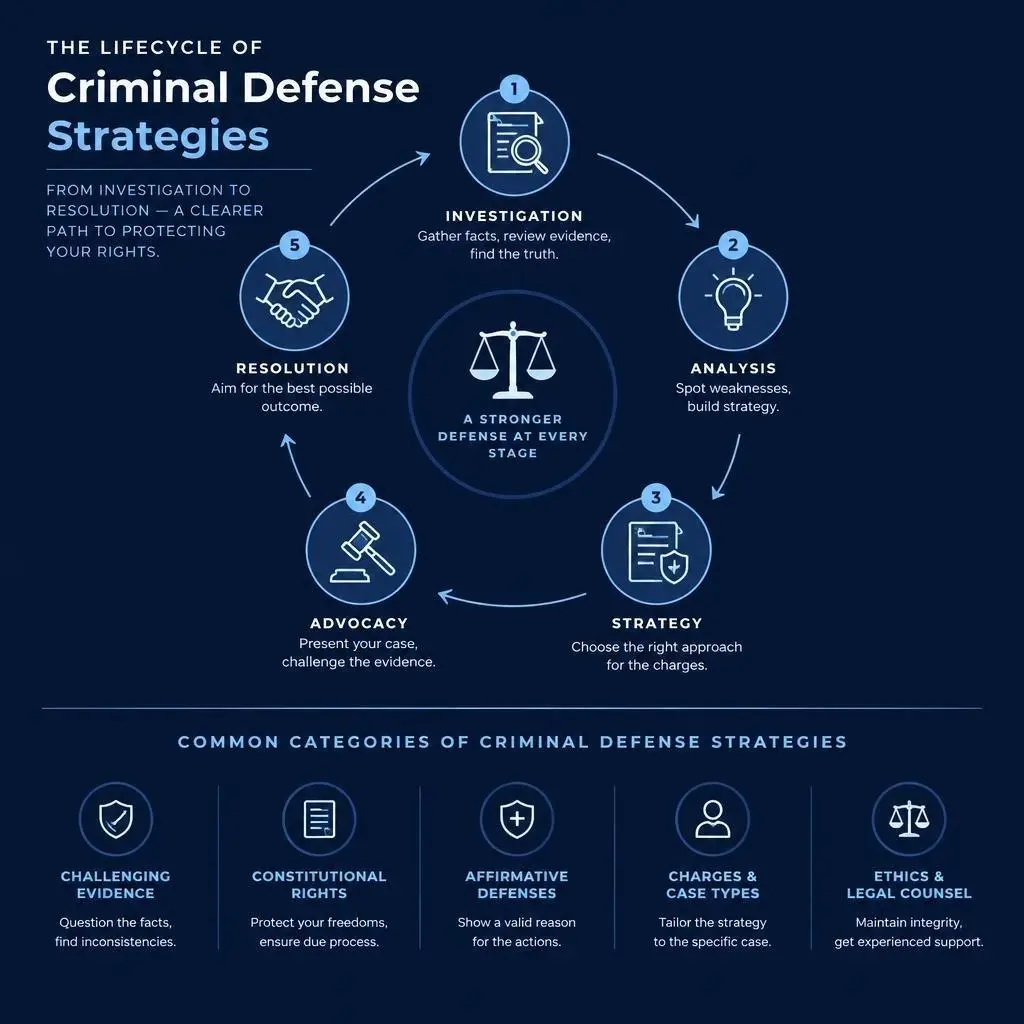
The cornerstone of any successful criminal defense strategy is a meticulous and thorough investigation of the case. Before any decisions can be made or arguments crafted, a defense attorney must immerse themselves in every detail of the alleged crime. This process begins with a comprehensive review of all available documentation, including police reports, charging documents, and any body-camera footage or surveillance video that may exist. Forensic records, such as DNA evidence, ballistics reports, or digital data, are scrutinized for accuracy, chain of custody issues, and potential weaknesses.
A critical step involves identifying potential prosecution weaknesses. This could range from inconsistencies in witness statements to procedural errors made by law enforcement. Defense attorneys meticulously analyze the prosecution’s evidence, looking for gaps, contradictions, or insufficient proof. Witness bias is also a significant factor; understanding a witness’s motivations, relationship to the parties involved, and prior statements can reveal avenues for cross-examination. Factual analysis extends to reconstructing the timeline of events, comparing the defendant’s account with other evidence, and identifying any discrepancies. This rigorous process of fact-finding and analysis allows attorneys to develop a coherent and compelling defense narrative.
Analyzing Evidence and Prosecution Pressure Points
Effective defense strategies often emerge from identifying and exploiting the pressure points within the prosecution’s case. One of the most common areas of vulnerability is eyewitness reliability. Research, including data from the Innocence Project, consistently shows that eyewitness misidentification is a leading cause of wrongful convictions, contributing to a significant percentage of DNA exonerations. Defense attorneys challenge the circumstances surrounding eyewitness identification, such as suggestive lineup procedures or the impact of stress and memory on perception.
The chain of custody for physical evidence is another critical area. Any break in this chain—meaning a failure to properly document who handled evidence, when, and where—can render that evidence inadmissible or significantly weaken its probative value. Forensic assumptions are also subject to challenge; defense experts may be brought in to dispute the methodology or conclusions of the prosecution’s forensic analysis. For instance, the reliability of breathalyzer tests in DUI cases or the interpretation of DNA evidence can be questioned.
Furthermore, defense counsel examines the probable cause that led to an arrest or search. If police acted without sufficient probable cause, any evidence obtained as a result might be suppressed. The initial charging documents are also carefully reviewed to ensure they accurately reflect the alleged offense and that all elements of the crime can be proven beyond a reasonable doubt. Understanding these potential weaknesses allows a skilled attorney to proactively file motions, negotiate plea deals, or prepare for trial. When confronting complex charges, securing dedicated legal support with a track record of success is paramount. For comprehensive and robust advocacy, many clients seek out aggressive criminal defense representation that meticulously dissects every aspect of the prosecution’s case.
Aligning Case Theory with Emotional and Juror Dynamics
Beyond the cold facts and legal statutes, a compelling defense strategy must also resonate with the human element of the courtroom: the jury. Developing a coherent narrative, or “case theory,” is essential. This theory isn’t just a collection of facts; it’s a unifying story that integrates the factual, legal, and emotional components of the case. It provides jurors with a framework to understand the events from the defense’s perspective.
Case themes are the memorable, overarching messages that encapsulate this narrative. For example, a theme might be “mistake, not malice” in a case of accidental harm, or “justice for the wrongly accused” in an identity dispute. These themes are designed to create a specific juror perception, guiding how they interpret evidence and testimony.
Emotional archetypes play a crucial role in this process. Attorneys often tap into universal human experiences and emotions—such as fear, betrayal, love, or the desire for fairness—to make the defense’s story relatable and persuasive. By crafting a narrative that aligns with these archetypes, the defense can foster empathy or understanding from the jury.
The process of voir dire, or jury selection, is the first opportunity to gauge and influence juror dynamics. Attorneys ask questions to identify potential biases and select jurors who are open to the defense’s narrative and committed to the presumption of innocence. Throughout the trial, from opening statements to closing arguments, every action, question, and piece of evidence presented is designed to reinforce the chosen case theory and themes. The goal is to build a credible and emotionally resonant story that persuades the jury that the prosecution has not met its burden of proving guilt beyond a reasonable doubt.
Core Substantive Defenses and Innocence Claims
At the heart of many criminal defense strategies lies the assertion of actual innocence or the demonstration of factual disputes that cast doubt on the prosecution’s claims. These strategies directly challenge the prosecution’s version of events, aiming to show that the defendant did not commit the crime, or that the evidence against them is unreliable.

A common and powerful defense is the alibi. This involves proving that the defendant was in a different location at the precise time the crime occurred, making their involvement impossible. Verifying an alibi often relies on concrete evidence such as digital timestamps from electronic devices, cellphone location data, ATM receipts, or surveillance footage from other locations. Eyewitness testimony from credible individuals who can confirm the defendant’s presence elsewhere is also crucial. The strength of an alibi defense hinges on its specificity and the corroborating evidence that supports it. With the proliferation of digital technology, proving or disproving an alibi has become increasingly reliant on forensic digital evidence analysis, which can either bolster a defense or expose its weaknesses.
Mistaken Identity and Challenging Identification Methods
Mistaken identity is a defense that directly challenges the prosecution’s ability to prove that the defendant is the person who committed the crime. This strategy is particularly relevant in cases where the evidence primarily relies on eyewitness accounts. As noted earlier, eyewitness misidentification is a significant factor in wrongful convictions.
Defense attorneys often scrutinize the methods used by law enforcement to identify suspects. This includes examining lineup procedures to ensure they were not suggestive, evaluating the circumstances under which an eyewitness first identified the defendant, and considering factors like lighting, distance, and the presence of weapons, which can all affect a witness’s perception and memory. The issue of cross-racial misidentification, where witnesses are less accurate at identifying individuals of a different race, is also a critical consideration.
Modern technology, such as facial recognition software, introduces new complexities and potential for error. The widely publicized case of a Detroit man wrongfully accused of shoplifting due to faulty facial recognition software in 2020 (using the 2026 current date) highlights the risks. Challenges to such technology, as well as to the confidence level of a witness (which often correlates poorly with accuracy), are central to this defense. The goal is to demonstrate to the jury that reasonable doubt exists regarding the identity of the perpetrator.
Affirmative Criminal Defense Strategies: Justification and Excuse
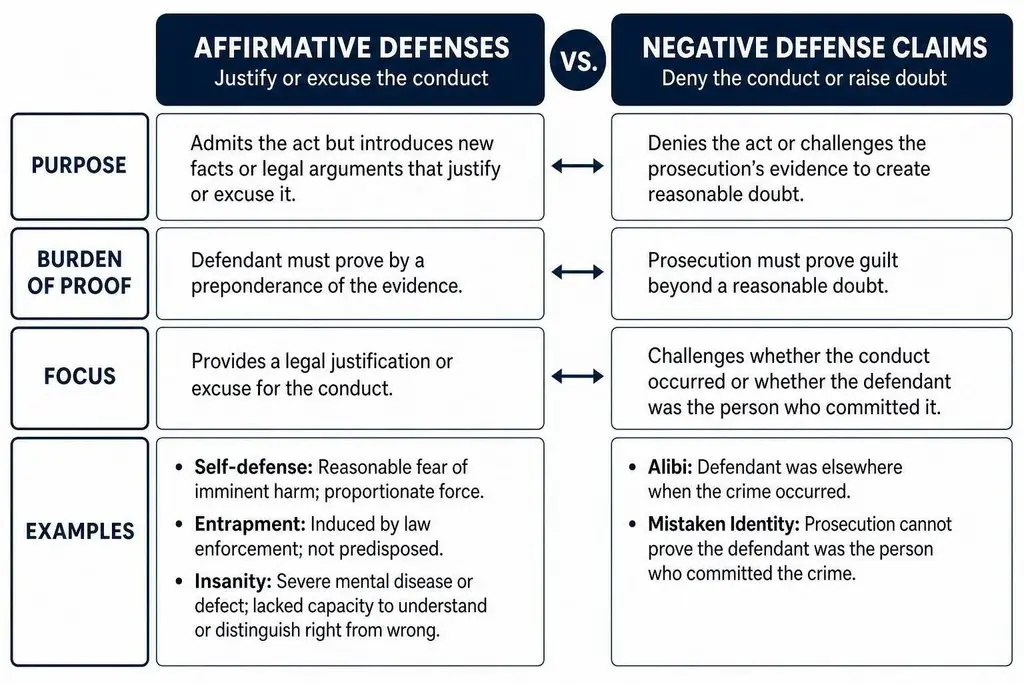
Unlike defenses that simply deny the prosecution’s allegations (known as “negative defenses” like alibi or mistaken identity), affirmative defenses introduce new facts or legal arguments that, even if the defendant committed the act, justify or excuse their conduct. These defenses typically shift the burden to the defendant to prove their claim by a preponderance of the evidence, rather than the prosecution having to disprove it.
One prominent affirmative defense is self-defense. This applies when a defendant used force to protect themselves or others from imminent harm. Key elements typically include a reasonable fear of immediate danger and the use of proportionate force—meaning the response was not excessive given the perceived threat. For instance, using deadly force might be justified if facing a threat of serious bodily injury or death.
Entrapment is another affirmative defense, asserting that law enforcement induced an individual to commit a crime they would not have otherwise committed. To prove entrapment, the defense must show that the idea for the crime originated with the police and that the defendant was not predisposed to commit that type of offense. This defense often arises in cases involving undercover operations or informants.
The insanity defense, while often sensationalized, is rarely used and even less frequently successful. It argues that due to a severe mental disease or defect, the defendant lacked the capacity to understand the nature of their actions or to distinguish right from wrong at the time of the crime. The M’Naghten rule, or variations of it, is a common legal standard for insanity. Proving a defendant’s mental state at the time of an offense is incredibly challenging, requiring extensive expert testimony and often facing public skepticism. In fact, statistics from 2022 (using the 2026 current date) indicate that the insanity defense is raised in less than 1% of felony cases and succeeds in only about 25% of those instances.
These affirmative defenses represent distinct legal arguments that, if successfully proven, can lead to an acquittal or a significant reduction in charges.
Procedural and Constitutional Challenges in Court
Beyond challenging the factual assertions of the prosecution, a robust criminal defense strategy frequently involves scrutinizing the legal process itself. Procedural and constitutional challenges can lead to the suppression of critical evidence, the dismissal of charges, or even a new trial. Defense attorneys are vigilant in identifying any violations of a defendant’s rights or deviations from established legal procedures.
Motion practice is a cornerstone of this approach. Pre-trial motions, such as motions to suppress evidence, motions to dismiss, or motions in limine, are filed to address legal issues before the trial begins. These motions argue that certain evidence should be excluded, that the charges lack legal merit, or that specific testimony should not be allowed.
Constitutional rights, enshrined in the U.S. Constitution, provide powerful safeguards. The Fourth Amendment protects against unreasonable searches and seizures, the Fifth Amendment includes the right against self-incrimination and due process, and the Sixth Amendment guarantees the right to counsel and a speedy trial. Any violation of these rights can have profound implications for a case. Defense counsel ensures statutory compliance, checking that all legal requirements and deadlines have been met by both the prosecution and law enforcement. A successful procedural challenge can sometimes result in the entire case being dismissed, highlighting the importance of a meticulous legal review.
Suppressing Evidence via Fourth and Fifth Amendment Violations
One of the most impactful procedural strategies is the suppression of evidence. This occurs when a court rules that certain evidence cannot be used by the prosecution because it was obtained in violation of a defendant’s constitutional rights.
The Fourth Amendment protects individuals from unlawful searches and seizures. If law enforcement conducts a search without a warrant, without probable cause, or without a recognized exception to the warrant requirement, any evidence discovered during that search may be deemed inadmissible under the exclusionary rule. This rule, established in cases like Mapp v. Ohio (1961), dictates that evidence obtained illegally cannot be used in court. Defense attorneys meticulously examine search warrants for defects, challenge the basis for warrantless searches, and scrutinize the scope of any search conducted.
The Fifth Amendment offers protection against self-incrimination, famously encapsulated by the Miranda warnings. If police fail to inform a suspect of their right to remain silent and right to an attorney before a custodial interrogation, any statements made by the suspect may be suppressed. Defense counsel investigates the circumstances of interrogations, looking for Miranda violations, coerced statements, or other tactics that undermine the voluntariness of a confession. The “fruit of the poisonous tree” doctrine extends the exclusionary rule, meaning that not only illegally obtained evidence itself, but also any evidence derived from that illegal evidence, can be suppressed. These challenges can significantly weaken the prosecution’s case, sometimes to the point of dismissal.
Mitigating Charges Through Lesser Included Criminal Defense Strategies
Even when a full acquittal seems unlikely, defense attorneys can employ strategies to mitigate the severity of the charges or potential penalties. One such approach is the “lesser included offense” strategy. This involves arguing that while the defendant may have committed some crime, the prosecution has failed to prove all the elements of the more serious charge. Instead, the evidence only supports conviction for a less severe, related offense.
For example, in a case of aggravated assault, a defense attorney might argue that while the defendant committed an assault, there was no intent to cause serious bodily harm, or no deadly weapon was used, reducing the charge to simple assault. This strategy can be particularly advantageous in plea negotiations, where the defense can leverage the possibility of a jury opting for a lesser charge to secure a favorable plea deal. It also provides a jury with an alternative to outright acquittal or conviction on the most serious charge, which can be appealing if they believe the defendant is partially culpable but the prosecution has overcharged the case.
The decision to pursue a lesser included offense strategy often involves a careful assessment of the evidence, the potential sentencing exposure for both charges, and the client’s willingness to accept a conviction for a less serious crime. This strategic maneuvering is a critical aspect of criminal defense, aiming to achieve the best possible outcome for the client even in challenging circumstances. Navigating these complex decisions requires seasoned legal guidance. A dedicated and understanding legal advocate can make all the difference, providing the support and expertise needed to explore every avenue for a favorable resolution. When seeking such guidance, many individuals look for a client-focused criminal defense team committed to protecting their rights and future.
Ethics, Client Rights, and Trial vs. Plea Decisions
The relationship between a criminal defense attorney and their client is built on a foundation of trust, confidentiality, and ethical obligations. Central to this is the attorney-client privilege, a legal protection that ensures all communications between a client and their lawyer remain confidential. This privilege is vital because it encourages clients to be completely honest with their attorneys, providing all relevant facts—even those that may be incriminating—without fear that these disclosures will be used against them. This full disclosure is essential for the attorney to build the most effective defense strategy.

However, this relationship also involves complex ethical considerations. A key principle is client autonomy. While attorneys provide expert legal advice, clients retain ultimate control over fundamental decisions, such as whether to plead guilty, whether to accept a plea bargain, whether to testify at trial, and whether to waive the right to a jury trial. The Supreme Court case McCoy v. Louisiana (2018) affirmed a defendant’s right to insist on their innocence, even if their defense lawyer believes it is in their best interest to admit guilt. This underscores the ethical imperative for attorneys to respect their client’s decisions, even when they conflict with the lawyer’s strategic judgment.
The decision between going to trial and negotiating a plea bargain is one of the most critical junctures in a criminal case. Plea bargaining is a dominant feature of the U.S. justice system, with 90-97% of federal criminal convictions resulting from guilty pleas. Attorneys must carefully assess the strength of the prosecution’s case, the potential sentencing exposure at trial versus a plea deal, and the client’s risk tolerance. Pre-trial pressure from the prosecution, often through advantageous plea offers that expire, can significantly shape these outcomes.
Attorneys also have an ethical duty to preserve issues for appeal. This means making timely objections, filing appropriate motions, and ensuring that any potential errors made by the court or prosecution are properly documented for future appellate review. Balancing confidentiality, client autonomy, and strategic considerations requires a skilled and ethical approach to criminal defense.
Frequently Asked Questions About Criminal Defense Strategies
What is the difference between an affirmative defense and a negative defense?
The distinction between affirmative and negative defenses lies primarily in their approach to the prosecution’s case and the burden of proof. A negative defensedirectly challenges one or more elements of the crime that the prosecution must prove. For instance, an alibi defense (claiming the defendant was elsewhere) or mistaken identity (claiming the prosecution has identified the wrong person) are negative defenses. They aim to show that the prosecution has not met its burden of proving guilt beyond a reasonable doubt. The burden remains entirely on the state to prove every element of the crime.
An affirmative defense, conversely, introduces new facts or arguments that, even if the defendant committed the alleged act, justify or excuse their conduct. Examples include self-defense, entrapment, or insanity. With an affirmative defense, the defendant typically bears the burden of proving their claim, usually by a “preponderance of the evidence” (meaning it’s more likely than not), though the specific standard can vary by jurisdiction. These defenses do not deny the act itself but rather seek to negate criminal culpability.
How does digital forensics impact an alibi defense?
Digital forensics has dramatically changed the landscape of alibi defenses, often providing powerful corroboration or, conversely, undermining a claim. Cell tower data can pinpoint a phone’s general location at a specific time, indicating whether a defendant’s device was near the crime scene or elsewhere. GPS recordsfrom vehicles, fitness trackers, or smartphones offer even more precise location data. Metadata validation from digital photos, emails, or social media posts can establish when and where a digital artifact was created, supporting or refuting a defendant’s presence.
While digital evidence can strengthen an alibi, it can also weaken it. Inconsistent digital footprints, such as a phone pinging near a crime scene when the defendant claims to be miles away, can be highly damaging. Defense attorneys must meticulously gather and analyze all relevant digital evidence, including electronic surveillance records, to construct a robust timeline and either bolster the defendant’s alibi or advise on alternative defense strategies if the digital evidence contradicts their claim.
Can a criminal charge be dismissed if evidence was obtained illegally?
Yes, a criminal charge can absolutely be dismissed, or at least significantly weakened, if key evidence against the defendant was obtained illegally. This principle is rooted in the exclusionary rule, which dictates that evidence gathered in violation of a defendant’s constitutional rights (primarily the Fourth and Fifth Amendments) cannot be used against them in court.
If a defense attorney successfully files a motion to suppress this illegally obtained evidence, and that evidence is crucial to the prosecution’s case, the prosecution may be left with insufficient proof to proceed. In such scenarios, the judge may dismiss the charges, or the prosecution may choose to drop the case due to a lack of viable evidence. This also extends to the “fruit of the poisonous tree” doctrine, meaning that any evidence derived from the initial illegal act can also be excluded. Therefore, identifying and challenging constitutional violations in how evidence was collected is a powerful defense strategy that can lead to favorable outcomes, including dismissal.
Conclusion
Navigating the complexities of the criminal justice system demands more than just a passing understanding of the law; it requires a strategic, multi-faceted approach to defense. From the initial investigation and meticulous analysis of evidence to the nuanced application of substantive and procedural defenses, every step is critical. We’ve explored how foundational elements like thorough case investigation and understanding prosecution pressure points lay the groundwork for a strong defense. We’ve also delved into core substantive defenses such as alibi and mistaken identity, and affirmative defenses like self-defense and entrapment, which offer distinct pathways to challenging allegations.
Furthermore, the power of procedural and constitutional challenges, particularly the suppression of illegally obtained evidence, underscores the importance of safeguarding a defendant’s rights throughout the legal process. The ethical framework governing attorney-client relationships, including confidentiality and client autonomy, ensures that defense strategies are not only legally sound but also aligned with the client’s fundamental rights and wishes.
An effective criminal defense strategy is a tailored legal defense, built on a foundation of rigorous investigation, strategic trial readiness, and an unwavering commitment to procedural safeguards. It is this comprehensive approach, guided by experienced legal counsel, that empowers individuals to protect their rights and pursue the best possible outcome when facing criminal charges.